Running your school
Your school software is a digital register
Software changed where a school's data is typed. For most schools it did not change what that data does for them. Here is the ladder, and where your school actually sits on it.
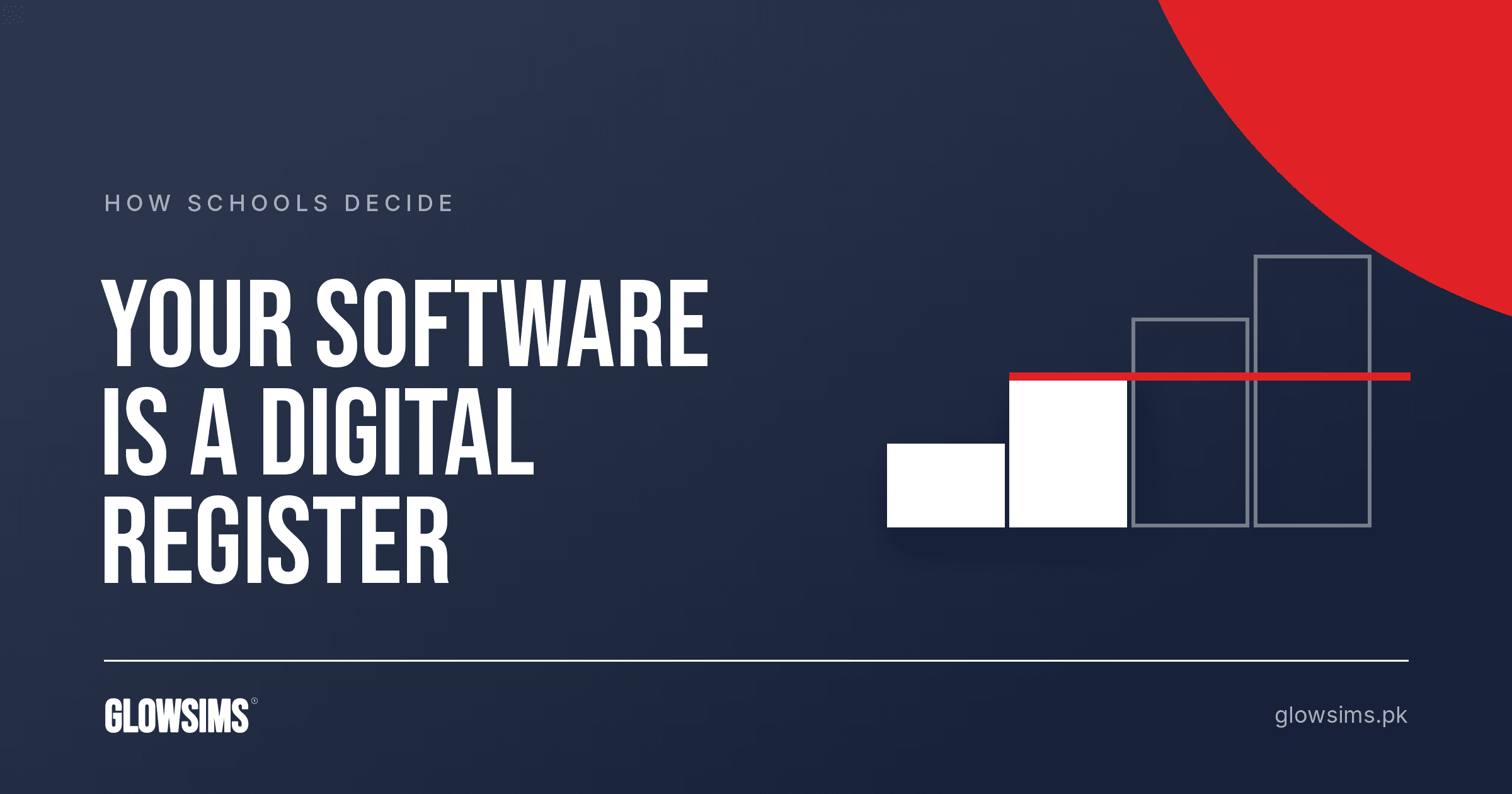
Before software, a school kept registers. Admissions in one, fees in another, attendance in a third, marks in a fourth.
Then software arrived. The admissions register became an admissions screen. The fee register became a fee screen. The attendance register became an attendance screen.
Look closely at what changed. The place where the data is typed. That is all.
The vendors competed on making that typing easier — more fields, faster entry, a mobile app. All useful. None of it answered the question an owner actually has, which is not "where do I put this?" but "what is this telling me?"
So we arrived at an odd position. A school with years of records sitting in a system, and an owner who still decides by instinct. Not because he is not capable. Because nobody built him the step between the two, and nobody told him it was missing.
The four levels
DIKW — data, information, knowledge, wisdom — is a decision-making framework from well outside education. It maps onto a school almost too neatly, and it is the clearest way I know to show owners where their system actually stops.
Data. The entries. A fee received. A student absent. A mark awarded. Paper registers hold data. So does every piece of school software ever sold.
Information. Data organised so a person can read it. The defaulter list. Today's attendance sheet. The result card. This is the level almost everyone has reached, and it is the level most school software stops at. It is genuinely useful — it is why schools bought software — and it is not the same as knowing anything.
Knowledge. Patterns across time. Not which students were absent today, but which student's attendance has been falling for three months. Not this term's results, but which class has improved year on year and which has quietly slipped. Not this month's admissions, but where enrollment is heading.
Wisdom. The decision, made while it still matters. Calling that family in March rather than discovering the problem in the final exam.
The gap between information and knowledge is where almost every school in Pakistan currently sits. And it is the gap nobody in this market talks about, because it is harder to build than another screen.
The difference, in one example
A list of absentees is information. Any system produces it.
The same student's attendance compared against his own last three years, against his class, and against the same month in previous sessions — that is knowledge. One tells you what happened. The other tells you something is happening.
The first requires today's data. The second requires years of it, clean, consistent, and in the same shape throughout. That is the whole difficulty, and it is why this gap stays open.
Three questions to put to your own system
Not features to look for. Questions to ask, with your system open in front of you.
One. Can it show me this year against last year, on the same screen? Not two reports I print and compare by hand. One view, both years. If every comparison in your school is done by a person holding two sheets of paper, your system is at information.
Two. Can it tell me something is changing before the term ends? A student slipping. A class drifting. Fee recovery weakening against the same month last year. If every answer arrives after the thing has already happened, the system is recording history, not supporting decisions.
Three. How many years of consistent data does it actually hold? This is the one owners skip, and it decides the other two. If your fee heads were renamed two years ago, if a campus changed its class naming, if you switched systems in 2021 and only brought the current students across — then the years are there but the comparison is not possible. The data exists and the history does not.
If the honest answer to all three is no, that is not a failure of your school. It is the market you bought in.
Why this gap is hard to close
It is worth being clear about why this has stayed open, because it explains why more features have not fixed it.
Knowledge needs years of clean data. Years of clean data need the system to have been implemented properly in the first place — the definitions agreed, the staff trained, the records consistent from the start rather than cleaned up later. And that needs a software company still standing, with the same product, carrying the same school's records, long after it sold them.
That is not a feature. You cannot add it in a release. It is the accumulated result of implementation done carefully and a company that lasted — which is why the companies adding intelligence on top of a digital register are solving the wrong end of the problem. There is nothing underneath it to be intelligent about.
If you are choosing a system this year
Ask the three questions above of every vendor you are considering.
Then ask a fourth, which tells you more than the other three together: ask how they implement. Who sets the definitions. Who trains the staff. What happens in month three when the first fee cycle exposes something nobody agreed. A vendor who answers that question in detail is a vendor whose data will still be worth something to you in five years. A vendor who moves quickly back to the feature list is selling you a register.
Ask us the same four. We would rather be judged on the answers than on a brochure.
Since 2013 we have been doing this for more than 1,200 schools across Pakistan, holding over a million student records. The length of that record is the point — not as a credential, but because years of consistent data is the only thing this problem can be solved with.
Message us on WhatsApp or book a demo.
Muhammad Shahbaz Akbar is the CEO of GLOWSIMS, built in Phalia and running Pakistani schools since 2013.